Start here
How a Radon Test Actually Works, What It Costs, and What to Expect.
Radon testing is simple in principle and easy to do wrong in practice. Here's what actually happens, in plain English: what the equipment does, how the two-day test works, where the monitor sits, and what your report means when it's over.
Radon Testing, the Short Version
The short version: A pro tester leaves a small air-quality monitor in the lowest floor you live on. It runs for 48 hours with windows and outside doors kept shut. An independent lab reads the data and sends a written report. If the two-day average is under 4.0 pCi/L (picocuries per liter — a measure of how much radon is in the air), no action is needed. If it's higher, the EPA recommends fixing the home — a routine, affordable job.
4.0pCi/L
the level where the EPA says to fix your home
48hrs
how long the test runs
The equipment
The Equipment: Pro Monitor vs. DIY Charcoal Kit
A professional radon test uses a sealed continuous monitor (basically a small, smart air-quality device) that sits in your house for at least 48 hours. It records the radon reading hour by hour for the whole test — not one guess at the end.
A DIY charcoal kit works very differently. It's a small canister you open, leave out, then reseal and mail to a lab for one average number. There's no record of what happened during those two days — no way to tell if a window got left open, the canister got moved, or the house got aired out halfway through.
Our professional monitors log more than radon — they also record temperature, humidity, air pressure, and any bumps or movement. If someone opens a window or picks up the monitor mid-test, the data shows it. That protects everyone, especially in a home sale. Our monitors are sealed on-site, and an independent lab reads the data — not us. We never grade our own tests.
What happens during the test?
The 48-Hour Test: What "Closed-House" Means
Real estate radon tests follow the national testing standard (called ANSI/AARST), which requires "closed-house conditions" — meaning windows and outside doors kept shut starting 12 hours before we arm the monitor, and kept shut for the full two days.
Closed-house doesn't mean sealed like a bunker. Your HVAC runs normally — heat or air conditioning on its normal cycle is expected. You can use the outside doors normally to come and go. What the standard rules out is deliberate ventilation: propped-open windows, a whole-house fan, or a fireplace damper left open when it wouldn't normally be.
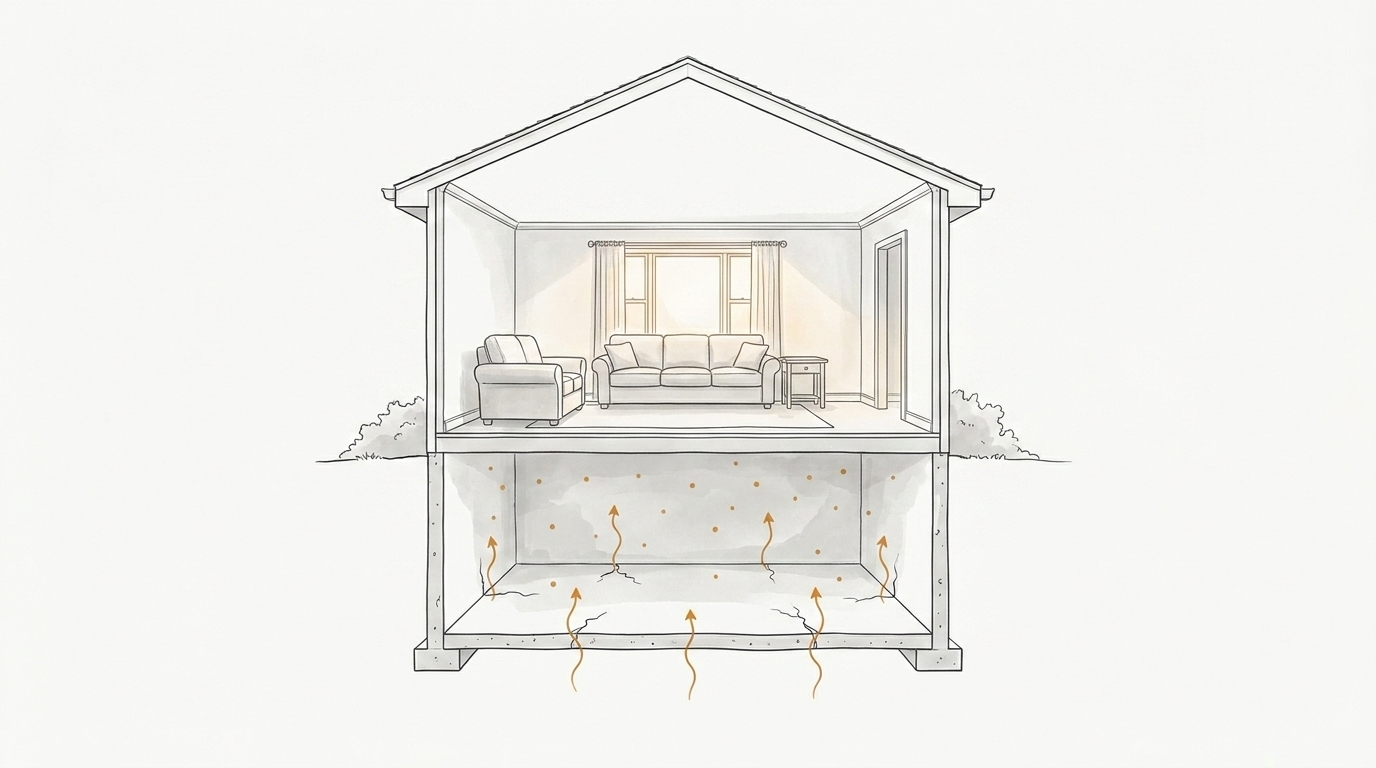
The reason is simple. Radon is a gas that seeps up from the soil under your foundation, and how much of it builds up inside depends on how much fresh air is exchanging with the outside. Open the house up mid-test and you reset the very thing the test is trying to measure — and the number stops meaning anything.
Where the monitor goes
Where the Monitor Sits in Your House
Where the monitor goes matters, and it's one of the easiest things to get wrong with a DIY kit. The standard calls for the lowest floor of the home you actually live on — a finished basement counts if you spend time down there; otherwise the lowest regularly-used floor.
From there, the monitor sits at least 20 inches off the floor, well away from windows, outside doors, and outside walls (where drafts throw off the reading). It also stays clear of HVAC supply and return vents, direct sunlight, and steamy or breezy rooms like bathrooms and kitchens. Once it's placed, it stays undisturbed for the full 48 hours. Radon collects near the ground and near the spots where it seeps up from the soil — so placing the monitor close to that, without interference, is what makes the reading real.
Reading your report
Reading Your Radon Test Report
Your report shows the hour-by-hour readings from the full test, plus one overall two-day average. That average is the number that matters, compared against 4.0 pCi/L — the level where the EPA says to fix your home.
If your average comes back at 4.0 pCi/L or higher, the EPA recommends fixing the home. Below that, no action is required — though the EPA is clear that any radon carries some risk. For context, the average American home tests at about 1.3 pCi/L, well below the action level. Most Birmingham homes test fine. If yours doesn't, it's a routine, one-time fix — usually a fan-and-pipe system that vents the radon outside.
The report comes from an independent lab, not from whoever set up the monitor. That separation is the whole point: the person running the test has no stake in whether the number comes back high or low.
Want the cost breakdown for a test like this? See what radon testing costs in Birmingham, including exactly what's inside the price.
When should you test?
When You Should Test for Radon
Buying or selling a home is the most common reason, and timing matters. Test during the inspection period so the result is in hand before closing, not after. See how the two-day test fits inside a standard inspection window for the full timeline. Real estate agents working with buyers on a contingency clock should see our page for agents.
If you're not buying or selling, it's still smart to test roughly every two years, even if nothing about the house has visibly changed. Radon levels shift with the soil, drainage around the foundation, and small cracks that open up over time.
Retest after any renovation that changes how the house breathes — a newly finished basement, a foundation repair, a new HVAC zone, or new windows can all change how much soil gas gets pulled inside. And always retest after a radon fix (mitigation system) is installed to confirm it's working, then again every couple of years.
Who does the testing?
Who Does Radon Testing in Alabama
Alabama doesn't currently require a state license to perform radon testing. That's a real gap, and it means the equipment and standard your tester uses are what actually separate a real result from a guess.
When you're picking who tests your home, ask three things: what monitor do they use, does it record hour-by-hour and flag if it's moved, and who reads the result? A sealed professional monitor that logs hourly and gets read by an outside lab is a very different product than a mail-in charcoal canister read by whoever sold it to you.
We run sealed professional monitors and send every test to an independent lab — we don't read our own results. We also don't sell or install radon fixes. Nothing about the number we hand you benefits us if it comes back high or low.
Ready to book a radon test around the Birmingham metro?
Common questions
Frequently Asked Questions
What's the difference between a radon test and a home inspection?
A radon test uses a dedicated air-quality monitor to measure radon in your house over at least 48 hours. A regular home inspection covers the structural and mechanical stuff — roof, plumbing, wiring — and doesn't measure radon unless you specifically add a radon test to it.
Do I really have to keep every window closed for the whole 48 hours?
Yes. Windows and outside doors stay closed starting 12 hours before we arm the monitor and through the full two days. You can open the outside doors normally to come and go — just don't leave windows or fireplace dampers open. HVAC runs normally.
Where in my house does the monitor go?
The lowest floor you actually live on (a finished basement counts), at least 20 inches off the floor, away from windows, outside walls, and HVAC supply or return vents. We handle placement when we arrive.
What happens if my result comes back above 4.0 pCi/L?
The EPA recommends fixing the home if the average is 4.0 pCi/L or higher. Fixing radon is a routine, one-time job for a licensed mitigation contractor — usually a fan-and-pipe system that vents the radon outside. We only test, we don't do the fix — so our recommendation isn't a sales pitch.
Do radon testers need a state license in Alabama?
No — Alabama doesn't currently require a state license for radon testing. That's actually a real gap, and it means the equipment used and the standard followed are what determine whether a result can be trusted. Ask any tester what monitor they use and who reads the result.